

Mon, November 9, 2026
Key Developments
Midterm Elections
Pain in the AI trade
Last Thursday, both the Nasdaq 100 and the Philadelphia Stock Exchange Semiconductors Index had their worst days since Covid, falling 6.3% and 12% respectively. The selloff extended beyond technology, affecting industrial and other companies whose earnings are increasingly tied to AI infrastructure spending.
Growing concerns surrounding rising leverage, higher costs of financing, lofty earnings expectations, and the pace of AI investment have weighed on the AI ecosystem over the last several months. The prospect of greater political scrutiny and potential restrictions on data center construction following the midterm elections may have accelerated an adjustment that was already underway. Additionally, the recent surge in flows to levered ETFs, historically high levels of margin debt, and potential position unwinding within the hedge fund community may have amplified the volatility.
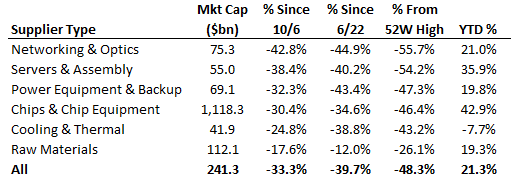
Notably, the hyperscalers (Amazon, Microsoft, Alphabet, and Meta) demonstrated greater resilience than many other AI-related companies. Their shares rallied on Wednesday and experienced comparatively smaller declines on Thursday.
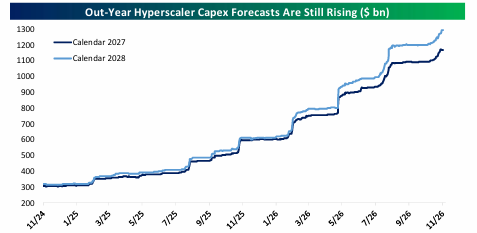
The potential for reduced AI spending may alleviate investor concerns surrounding hyperscaler overinvestment, declining free cash flows, and rising financial leverage. For now, however, there is little evidence of an imminent slowdown, as hyperscaler capital spending forecasts remain elevated.
U.S. Labor Market
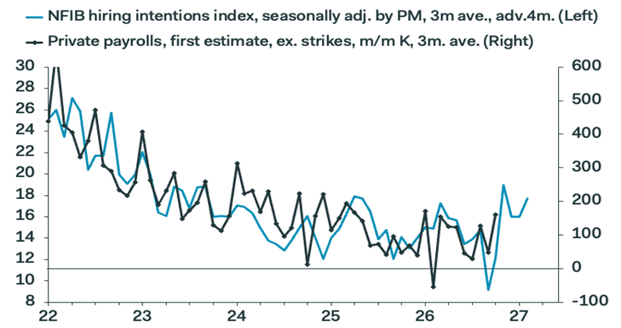
Labor demand was strong in October. Payrolls rose by 165,000 in October, well ahead of the expectations for a 70,000 increase. Payroll gains for the prior two months were revised upward by a combined 84,000. The unemployment rate fell to 4.1%. Moreover, average hourly earnings rose by 0.4%, beating the estimate of 0.3%. The strength in October payrolls is consistent with the improvement in other labor market indicators such as JOLTS job openings, new hires, and the quits rate. Improved momentum in the labor market should support consumer spending as we head into 2027.
Markets
The midterm elections may have accelerated the market rotation that has been a defining characteristic of U.S. equities throughout 2026. Despite an 8% decline in the technology sector last week, six of the ten other S&P 500 sectors posted positive returns. The equal-weight S&P 500 reached a record high on Wednesday and has outperformed its market-capitalization-weighted counterpart by more than seven percentage points since the beginning of October.
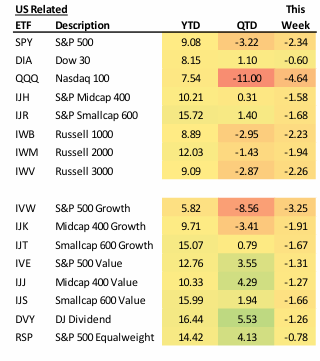
Outside the U.S., the MSCI Emerging Markets Index fell over 4%, weighed down by the benchmark’s significant exposure to semiconductor stocks.
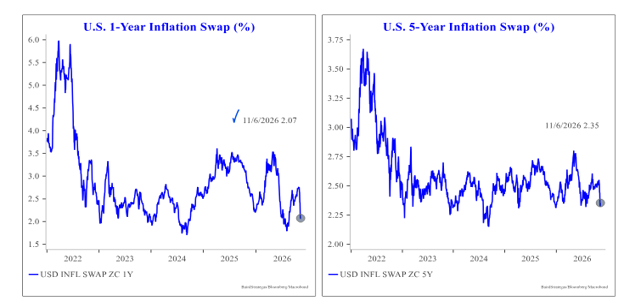
Treasury yields declined across the curve. The probability of a December quarter-point interest rate increase fell to below 70% before finishing the week at 78% after the stronger-than-expected October employment report. Market-based inflation expectations ticked down last week, perhaps reflecting the significant decline in oil prices over the last two weeks.
This Week
The key economic releases are October CPI (Tuesday) and PPI (Friday).
Chart of the Week
The midterm elections introduced another layer of uncertainty surrounding the AI investment cycle, particularly the outlook for data center construction.
However, it should be noted that hyperscaler spending forecasts continued to rise. In fact, forecasts have made new highs over the last month.
Written By Brian Presti
--
Brian Presti, CFA®, Chartered SRI Counselor℠, is Chief Investment Officer and a shareholder at TFC Financial Management. He oversees the firm’s investment strategy, asset allocation, sustainable responsible investing, and portfolio management processes and leads the firm’s Investment Committee. Prior to joining TFC in 2023, Brian was Director of Portfolio Strategy at The Colony Group, Chief Investment Officer of Harvest Capital Management and an equity analyst and portfolio manager with DL Carlson Investment Group. He began his career in 1997. As CIO, he is responsible for evaluating investment managers and implementing portfolio strategies designed to support long-term client objectives.
--
Disclosures:
- Registration with the SEC should not be construed as an endorsement or an indicator of investment skill or acumen.
- Past performance is not indicative of any specific investment or future results. Views regarding the economy, securities markets or other specialized areas, like all predictors of future events, cannot be guaranteed to be accurate and may result in economic loss to the investor.
- Investment strategies, philosophies and allocation are subject to change without prior notice.
- The securities identified and described do not represent all of the securities purchased, sold, or recommended for client accounts. The reader should not assume that an investment in the securities identified was or will be profitable.
- Any references to outside content are listed for informational purposes only and have not been verified for accuracy by the Advisor.
- This communication may include opinions and forward-looking statements. All statements other than statements of historical fact are opinions and/or forward-looking statements (including words such as “believe,” “estimate,” “anticipate,” “may,” “will,” “should,” and “expect”). Although we believe that the beliefs and expectations reflected in such forward-looking statements are reasonable, we can give no assurance that such beliefs and expectations will prove to be correct.