

Thu, November 5, 2026
The election resulted in a historic Democratic sweep that exceeded the blue wave in 2006. Democrats exceeded expectations in the House (estimated gain of 40-45 seats) and the Senate (7 flips with potential for 8). Additionally, Democrats made significant strides at the state level. Democrats are set to win a majority of governorships (including 9 of the 10 largest states) for the first time since 2010.
Market reactions to elections are typically volatile and unpredictable. This time has been no different. Futures were under pressure Tuesday night (at one point S&P 500 down 1.5%, Nasdaq down 2.5%) only to reverse sharply Wednesday morning. Major U.S. benchmarks rallied sharply yesterday. The Dow Jones Industrial Average had its best day since April 2025. Today markets are experiencing widespread selling. The post-election volatility likely results from both fundamental and technical factors as investors reassess the economic outlook and unwind positioning or hedging implemented before the election.
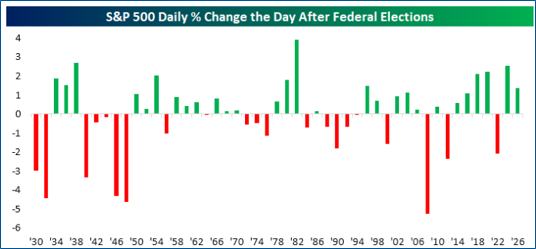
Below we discuss our key takeaways and the potential economic and market implications as we close out 2026 and head into 2027. We focus on the three critical areas we have highlighted in our past commentaries: AI investment, monetary policy, and the war with Iran.
AI Investment/Data Center Construction
A potential slowdown in data center construction may be the most significant development of the Democratic sweep. The AI infrastructure buildout has been a material tailwind for technology sector earnings growth and more recently has benefitted other sectors such as industrials. AI investment has also provided a growing contribution to overall economic growth.
Congress may challenge 100% expensing for capital equipment, a provision that has been a boon for data center construction. Trump would likely veto any proposals, but Congress may use this as leverage during the debt ceiling debate which could arise later in 2027. This topic is where the gubernatorial results may have more impact. Several states have already curtailed, paused, or placed strict regulatory guardrails on new data center construction. During Tuesday’s election, 40 out of 41 data center ballot initiatives were rejected by voters at the state or local level. (The New Republic)
The potential implications are lower earnings growth for sectors or companies more levered to the AI infrastructure buildout. Additionally, a reduction in non-residential fixed investment could dampen economic growth. This component had a significant contribution to U.S. GDP over the last three quarters. Since the election, many of the largest individual stock declines have occurred within sectors more levered to the data center buildout. Examples include semiconductors, networking equipment companies, and specific industrial stocks. We note that weakness in these groups did not suddenly surface after the election. The election may have accelerated a trend that already existed.
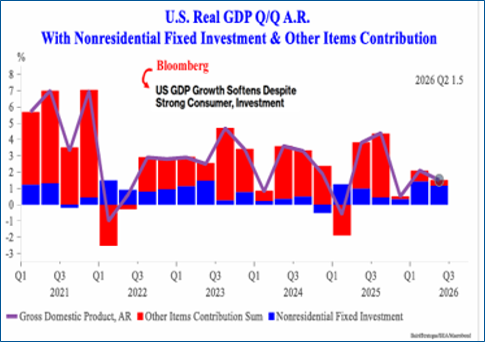
Importantly, the economic and investment implications of reduced AI spending may not be uniformly negative. For example, reduced spending from the mega-cap hyperscalers (Amazon, Alphabet, Meta, and Microsoft) may alleviate investor concerns related to overinvestment. Lower spending could lead to reduced debt issuance from the hyperscalers, mitigating concerns about rising leverage.
Lastly, we can’t predict exactly what methods will be used at the Congressional and state levels to curtail data center construction. The removal of 100% expensing would have broad implications. At the state and local level, moratoria would have much different effects than reducing subsidies, raising taxes, implementing localized zoning, or mandating energy usage restrictions.
Monetary Policy
The election results shouldn’t influence the FOMC’s (Federal Open Market Committee) decision at the December meeting. However, several factors may reduce the probability of an extended hiking cycle. More specifically, oil prices have declined significantly over the last two weeks (falling approximately 8% yesterday). Additionally, fiscal policy will likely transition from stimulus in 2026 to tightening in 2027. Fiscal stimulus this year included OBBA tax refunds, 100% expensing for capital equipment, and a reduced effective tariff rate. As we head into 2027, sequentially these benefits may fade while divided government could constrain new fiscal stimulus.
War with Iran
We will refrain from predicting or handicapping the ultimate outcome. That’s been a difficult proposition. However, on the margin, we believe the election results increase the probability of a resolution or at least a reprieve from hostilities. Brent Crude Oil has fallen 20% over the last two weeks. However, the prices of crucial refined products such as diesel have remained elevated due to persistent supply chain disruptions.
Summary
The primary near-term risk is a slowdown in AI investment and the resulting effects on earnings and economic growth. We expect volatility to persist as long as this issue is front and center. Investors will likely assess and reassess the effects of the changing political landscape on AI investment over the next several months.
From a portfolio strategy perspective, we believe there are four key takeaways. First, the potential for slower growth, reduced inflationary pressures, and tighter financial conditions are all supportive of high-quality fixed income. Second, developed international stocks are more likely to provide diversification benefits given their significantly lower exposure to the technology and communication services sectors. Third, recent events may continue to support the rotation within the U.S. market, a trend we believe began last October. Lastly, quality companies with high levels of profitability, low levels of debt, and consistent earnings quality may be better positioned to provide relative resilience in an uncertain and volatile environment.
Sincerely,
--
Brian Presti, CFA®, Chartered SRI Counselor℠, is Chief Investment Officer and a shareholder at TFC Financial Management. He oversees the firm’s investment strategy, asset allocation, sustainable responsible investing, and portfolio management processes and leads the firm’s Investment Committee. Prior to joining TFC in 2023, Brian was Director of Portfolio Strategy at The Colony Group, Chief Investment Officer of Harvest Capital Management and an equity analyst and portfolio manager with DL Carlson Investment Group. He began his career in 1997. As CIO, he is responsible for evaluating investment managers and implementing portfolio strategies designed to support long-term client objectives.
Renée Kwok, CFP®, is President and CEO of TFC Financial Management, a fee-only registered investment advisor providing comprehensive financial planning and wealth management services. She has over three decades of experience advising individuals and families on investment strategy, retirement planning, tax planning, and multi-generational wealth management. Renée joined TFC Financial in 1991 and leads the firm’s financial planning and investment advisory services while serving on the firm’s Investment Committee. Prior to TFC, she worked as a security analyst at Putnam Investments and as an investment analyst at Asian Oceanic Limited, a Hong Kong merchant bank.