

Mon, September 28, 2026
Key Developments
U.S. Treasury yields continued to march higher
Treasury yields continued to rise across the curve. The 2-, 10-, and 30-year yields reached their highest levels since 2024, 2007, and 2004, respectively. Wednesday was the worst day for the Bloomberg U.S. Aggregate Bond Index since Liberation Day.
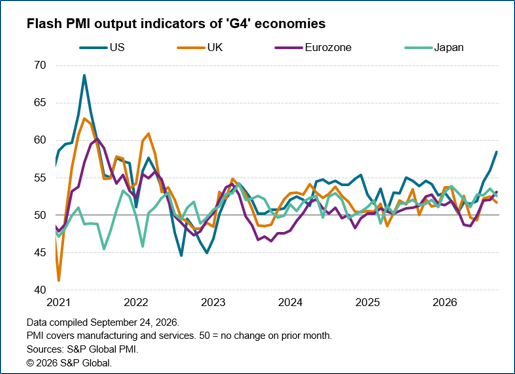
What was behind last week’s leg higher in bond yields? We would point to two catalysts on Wednesday. First, economic data released that day suggested U.S. economic growth remains strong and may be gaining momentum. The flash S&P Global U.S. Composite PMI exceeded expectations and reached its highest level since July 2021. Both the manufacturing and services components were well above consensus. In addition, the gap between U.S. output indicators and those of other developed economies widened to its largest level since 2021. This divergence may also help explain the recent strength of the U.S. dollar relative to most other currencies.
Second, the federal government’s auction of new 5-year Treasury notes saw weak demand. More specifically, the auction produced the second-largest tail of any auction since 2010. The tail is the difference between the yield at auction and the yield at which the security traded immediately beforehand (known as the when-issued yield). Despite the rise in yields leading into the auction, investors still required additional compensation to participate.
Bad Breadth
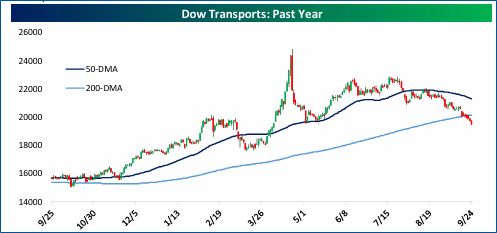
Market breadth narrowed as investors continued to favor large-cap growth stocks and AI-related companies. Investors may be growing concerned about pressure on profit margins in many cyclical industries amid the broad-based rise in commodity prices, particularly diesel. For example, through last Thursday, the Dow Transports had declined in seven of eight trading days and was well into correction territory. The flattening yield curve has also pressured bank stocks amid concerns about compressing net interest margins.
Technology and other AI-related stocks are not immune to higher rates and input costs, but their earnings growth is viewed as more resilient in the near term given the momentum behind the AI infrastructure buildout.
Despite the spike in yields and elevated commodity prices, stocks have been remarkably resilient. However, beneath the surface of the headline index returns, fewer stocks have been climbing the proverbial wall of worry.
Markets
U.S. stocks were mixed. The S&P 500 rose 1.23%, while the Russell 2000 Index of small-cap stocks fell 0.79%. The MSCI EAFE Index of developed-market stocks rose 0.20%, and the MSCI Emerging Markets Index advanced 1.29%. The U.S. Dollar Index also rallied and has risen 2.3% in just over two weeks.
This Week
The key economic release this week is Friday’s September employment report. Semiconductor bellwether Micron reports earnings on Wednesday.
Chart of the Week
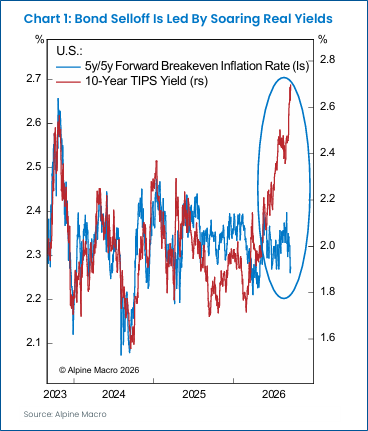
Last week, we highlighted the surprising decline in market-based inflation expectations. The spike in yields this month has instead been led by real yields. The rise in real yields primarily reflects improved economic momentum and may also reflect a reassessment of the economy’s neutral real policy rate.
Written By Brian Presti
--
Brian Presti, CFA®, Chartered SRI Counselor℠, is Chief Investment Officer and a shareholder at TFC Financial Management. He oversees the firm’s investment strategy, asset allocation, sustainable responsible investing, and portfolio management processes and leads the firm’s Investment Committee. Prior to joining TFC in 2023, Brian was Director of Portfolio Strategy at The Colony Group, Chief Investment Officer of Harvest Capital Management and an equity analyst and portfolio manager with DL Carlson Investment Group. He began his career in 1997. As CIO, he is responsible for evaluating investment managers and implementing portfolio strategies designed to support long-term client objectives.