

Mon, September 21, 2026
Key Developments
Fed raises interest rates
As expected, the Federal Reserve raised its benchmark interest rate by a quarter point. The vote was unanimous. Chairman Kevin Warsh did not submit his own forecasts for the Summary of Economic Projections. The median projection from other participants suggests one additional hike by year-end, followed by an extended pause in 2027.
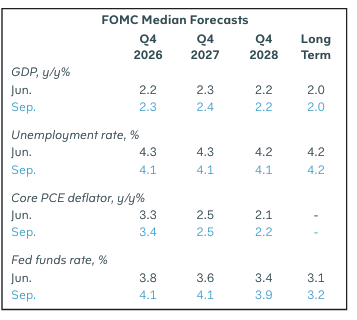
Market expectations are more hawkish than the Fed’s forecast with the divergence seen in 2027. After one more hike this year, the market is projecting two additional hikes in 2027. After the Fed’s decision and Warsh’s press conference, the treasury yield curve continued to flatten. For the week, 2-year yields rose 13 basis points while 10 and 30-year yields were little changed.
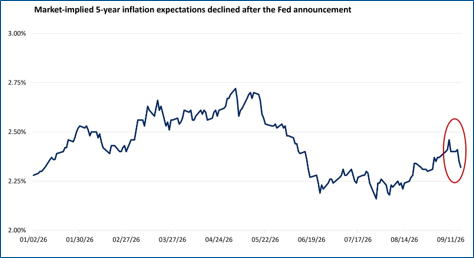
Interestingly, and perhaps surprising to many, inflation expectations have remained anchored despite persistent above-target inflation. In fact, market-implied 5-year inflation expectations declined after the Fed announcement, suggesting confidence that monetary policy will ultimately bring inflation back toward target.
Additionally, the Bank of Japan (BOJ) decided to raise its benchmark interest rate to 1.25%, the highest level in three decades. Markets expect at least one additional hike by January 2027.
U.S. consumers are still spending
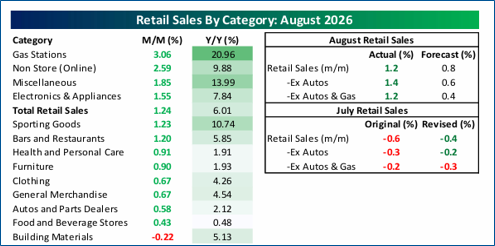
Retail sales were strong in August. The control measure of retail sales rose by 1.4%, the strongest monthly increase since September 2024, and well above expectations for a 0.5% gain. Moreover, sales were broad-based with 12 of the 13 individual categories showing growth during the month.
Markets
U.S. Equities
U.S. equity breadth narrowed during the week. Although the S&P 500 fell just 0.06%, most sectors declined more than 1%, with technology and healthcare the only sectors to finish higher. The Russell 2000 index of small companies declined 1.47%. While small companies are still outpacing large companies year-to-date, the gap has narrowed by close to 7.5% this quarter.
International Equities
Overseas, the MSCI EAFE Index and MSCI Emerging Markets Index declined 1.46% and 0.56% respectively.
Fixed Income
Although the U.S. Dollar Index has risen just 2% this year, it has gained some strength recently. The index rose over 1% for the week to reach its highest level since late July. The recent strength likely reflects both the shift toward a more restrictive U.S. monetary policy outlook and expectations that U.S. economic growth will remain relatively resilient compared with other major economies.
This Week
The U.S. economic calendar is light this week, shifting attention toward trade and geopolitical developments. Investors will monitor the resumption of U.S.-China trade talks ahead of the planned summit between President Trump and Chinese President Xi Jinping later this week.
Chart of the Week
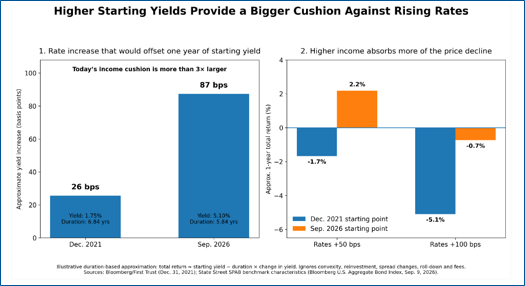
One silver lining of higher yields is….higher yields! High-quality bonds now offer considerably more income than they did several years ago. Just as importantly, higher starting yields provide a larger cushion against potential price declines if further interest rates increase further.
Written By Brian Presti
--
Brian Presti, CFA®, Chartered SRI Counselor℠, is Chief Investment Officer and a shareholder at TFC Financial Management. He oversees the firm’s investment strategy, asset allocation, sustainable responsible investing, and portfolio management processes and leads the firm’s Investment Committee. Prior to joining TFC in 2023, Brian was Director of Portfolio Strategy at The Colony Group, Chief Investment Officer of Harvest Capital Management and an equity analyst and portfolio manager with DL Carlson Investment Group. He began his career in 1997. As CIO, he is responsible for evaluating investment managers and implementing portfolio strategies designed to support long-term client objectives.