Mon, November 2, 2026
Key Developments
Mega-Cap Technology Earnings
Earnings from the hyperscalers (Meta, Alphabet, Amazon, and Microsoft) intensified concerns about the sustainability of AI investment. The debate has increasingly shifted from the strength of demand for AI infrastructure to whether—and when—these enormous investments will generate adequate returns. Adding to investor concerns is the growing reliance on external financing, including debt and equity, to support capital spending.
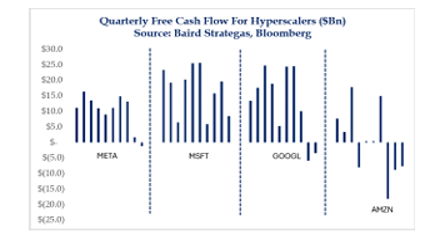
These issues were at the forefront of Meta, Alphabet, and Amazon’s earnings. Meta reported negative free cash flow in the third quarter, marking the first time the company has done so since its 2012 IPO. Additionally, Meta increased its capital expenditures guidance and announced it will create a new class of shares to help finance its investment plans. Alphabet’s quarterly cash burn was $9.1 billion, marking the second straight quarter of negative free cash flow. Amazon’s trailing 12-month free cash flow fell to negative $42.4 billion. The exception was Microsoft where free cash flow generation was strong due to the significant cash generation from its legacy business.
Importantly, demand was not the problem. Cloud revenue grew significantly across the hyperscalers. The issue is that revenue growth has not yet translated into profitability.
Ultimately, the key question is the sustainability of the growth rate of AI investment. As financing costs and investor scrutiny increase, the hyperscalers may ultimately moderate capital spending by delaying, scaling back, or reprioritizing projects. Given the hyperscalers’ significant capital expenditures projections, a slowdown could have ripple effects across the entire AI ecosystem.
FOMC Meeting and Press Conference
As expected, the FOMC left rates unchanged. The statement and press conference offered few surprises. The Committee upgraded its assessment of the economy (from “solid” to “strong”), acknowledged that inflation remained elevated, and reaffirmed its commitment to provide price stability. Markets still expect a quarter-point rate increase in December, although the probability declined from 80% after the press conference to 72% by Friday.
U.S. GDP
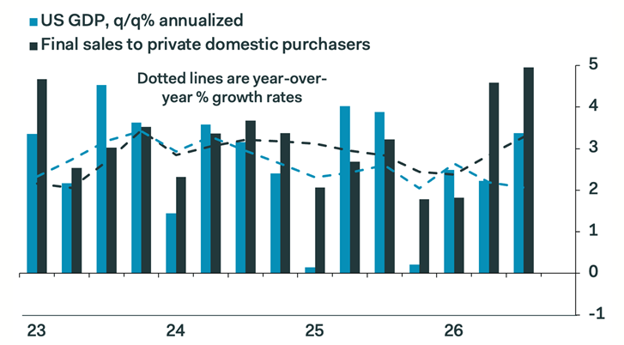
Economy growth remained strong in Q3. Q3 GDP rose at an annualized rate of 3.4%, slightly above the consensus of 3.2%. Fixed investment and personal consumption were the primary growth drivers. Private fixed investment surged 9.4%, supported by continued investment in the AI infrastructure buildout. IP and software investment increased by 8.4% while equipment investment jumped 20.8%. Despite the fading boost from tax refunds and high energy prices, consumer spending rose 3.8%, maintaining the pace of the second quarter.
Lastly, final sales to private domestic purchasers, a broad measure of economic growth that strips out several of the more volatile components of GDP, grew at a brisk annualized pace of 4.9%.
Markets
Despite the weakness in technology stocks, continued rotation into other areas of the market helped mitigate the S&P 500’s weekly decline. Market breadth improved significantly in October, reversing much of September’s deterioration. Several sectors posted gains for the week, supported by earnings, lower bond yields, and strong economic data. The equal-weight S&P 500 and the Russell 2000 index of small companies finished higher for the week, suggesting that weakness in the largest technology stocks did not extend uniformly across the broader market.
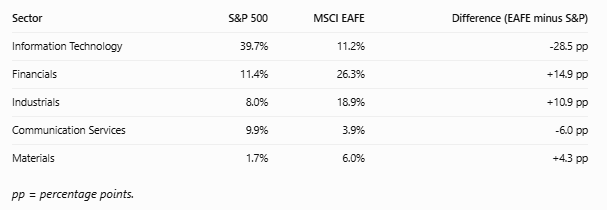
International equity performance was mixed. The MSCI Emerging Markets Index declined 0.72%, reflecting its greater exposure to technology stocks, particularly semiconductor companies. In contrast, the MSCI EAFE Index of developed markets gained 0.87%. Although developed international markets face their own economic and geopolitical challenges, their significantly lower exposure to technology may provide some insulation from continued uncertainty surrounding AI investment and spending.
Bonds rallied as yields fell across the U.S. Treasury curve. Notably, the decline in treasury yields in October coincided with generally stronger than expected inflation data and higher oil prices.
This Week
36% of companies in the S&P 500 will report earnings this week. The key economic release is the October employment report on Friday. And, of course, there is the small matter of the midterm elections!
Chart of the Week
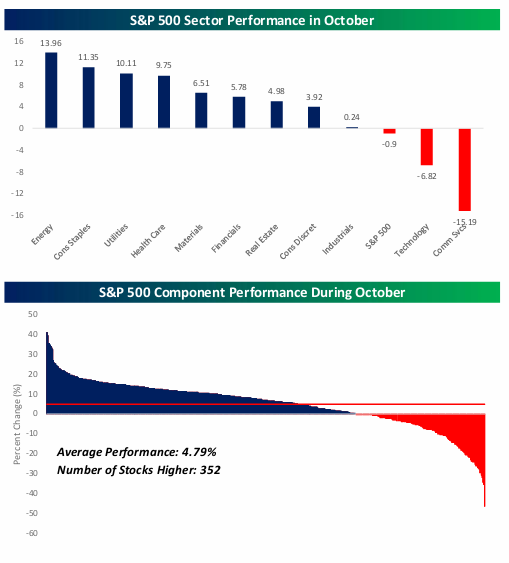
Despite a rough October for the technology and communication services sectors, the S&P 500 posted a modest decline. Nine sectors finished the month higher, while the average stock gained 4.79%.