

Mon, November 16, 2026
Key Developments
Hot Inflation Data
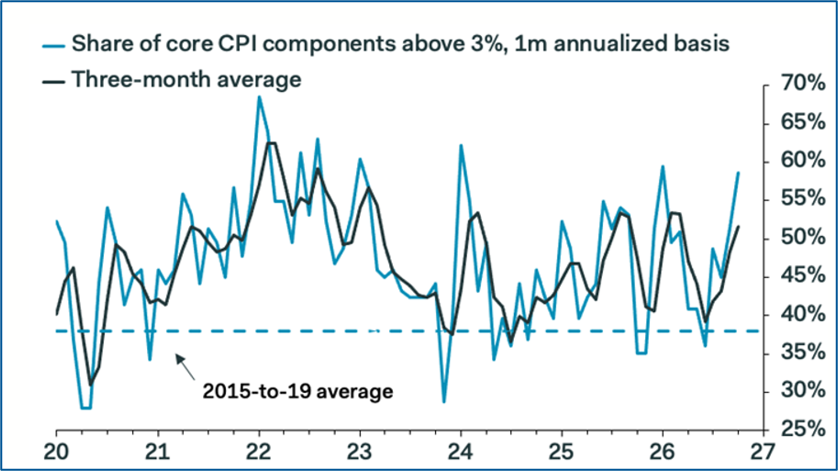
The October Consumer Price Index (CPI) revealed broad-based inflationary pressures. Headline and core CPI rose 0.4% and 0.3%, respectively, month-over-month, both exceeding expectations. More concerning was the breadth of inflation: the share of core CPI components experiencing monthly price increases equivalent to an annualized rate above 3% rose to 59% in October from 51% in September. Based on the CPI report, economists estimate that the core Personal Consumption Expenditures (PCE) price index, the Federal Reserve's preferred inflation gauge, may have increased to 3.3% from 3.1% in September.
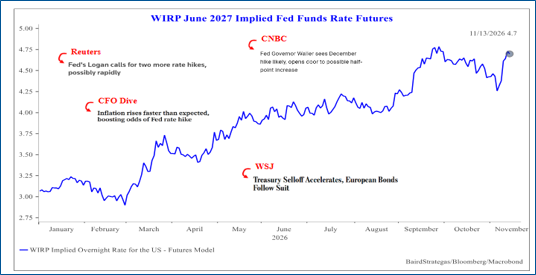
The report reinforced expectations for additional monetary tightening, with futures markets pricing in an approximately 89% probability of a 25-basis-point rate increase at the Fed's December meeting. Persistent inflation pressures could complicate the Fed's efforts to stabilize prices without undermining economic growth.
Jensen Huang Resigns
Nvidia co-founder and CEO Jensen Huang resigned from his leadership and board positions following disclosures that raised questions about potential conflicts of interest and corporate governance. Chief Financial Officer Colette Kress was named interim CEO while the board searches for a permanent replacement.
The implications could extend well beyond Nvidia. The company occupies a central position in the global AI infrastructure buildout, serving not only as a leading supplier of advanced semiconductors but also as an investor and financing partner to companies throughout the AI ecosystem. Its extensive financial relationships have earned it the nickname "the central bank of AI."
Although it is too early to assess the full consequences of Huang's departure, several potential risks warrant monitoring. These include heightened regulatory scrutiny, tighter restrictions on semiconductor exports, uncertainty surrounding Nvidia's strategic direction, a shift in the competitive landscape, and a possible reassessment of valuations across the AI sector.
The company’s earnings report and conference call on Tuesday should be one of the key market events this week.
Markets
Global equities rebounded from the previous week's declines, with broad-based gains across U.S. markets. All 11 S&P 500 sectors advanced for the week. Semiconductor stocks remained particularly volatile. The Philadelphia Semiconductor Index surged 17% over four trading days through Wednesday, following a 15% decline over the preceding four sessions.
International equities also advanced, with gains in both the MSCI EAFE and MSCI Emerging Markets indices. Emerging markets benefited in part from renewed strength in semiconductor stocks.
Meanwhile, U.S. Treasury yields rose sharply across the yield curve, particularly following Tuesday's stronger-than-expected CPI report. Investors revised their expectations for monetary policy, with futures markets now pricing in three additional rate quarter-point rate increases through the middle of 2027.
This Week
Markets could experience heightened volatility as investors digest Nvidia's earnings report and conference call on Tuesday and prepare for Anthropic's highly anticipated initial public offering. Both events could provide important signals about investor confidence in the AI sector.
On the economic front, Tuesday's October retail sales report will offer additional insight into the strength of consumer spending and the resilience of the U.S. economy.
Chart of the Week
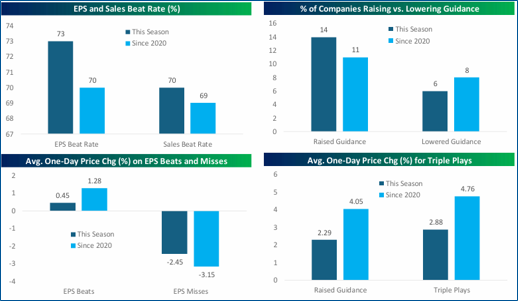
Earnings season winds down with Walmart’s report on Thursday. While the percentage of companies that beat sales and earnings expectations and/or raised guidance has been historically strong, the stock price reactions to positive earnings surprises have been historically weak. After several quarters of exceptional earnings growth, the bar may be high relative to investor expectations.
Written By Brian Presti
--
Brian Presti, CFA®, Chartered SRI Counselor℠, is Chief Investment Officer and a shareholder at TFC Financial Management. He oversees the firm’s investment strategy, asset allocation, sustainable responsible investing, and portfolio management processes and leads the firm’s Investment Committee. Prior to joining TFC in 2023, Brian was Director of Portfolio Strategy at The Colony Group, Chief Investment Officer of Harvest Capital Management and an equity analyst and portfolio manager with DL Carlson Investment Group. He began his career in 1997. As CIO, he is responsible for evaluating investment managers and implementing portfolio strategies designed to support long-term client objectives.
--
Disclosures:
- Registration with the SEC should not be construed as an endorsement or an indicator of investment skill or acumen.
- Past performance is not indicative of any specific investment or future results. Views regarding the economy, securities markets or other specialized areas, like all predictors of future events, cannot be guaranteed to be accurate and may result in economic loss to the investor.
- Investment strategies, philosophies and allocation are subject to change without prior notice.
- The securities identified and described do not represent all of the securities purchased, sold, or recommended for client accounts. The reader should not assume that an investment in the securities identified was or will be profitable.
- Any references to outside content are listed for informational purposes only and have not been verified for accuracy by the Advisor.
- This communication may include opinions and forward-looking statements. All statements other than statements of historical fact are opinions and/or forward-looking statements (including words such as “believe,” “estimate,” “anticipate,” “may,” “will,” “should,” and “expect”). Although we believe that the beliefs and expectations reflected in such forward-looking statements are reasonable, we can give no assurance that such beliefs and expectations will prove to be correct.