

Tue, November 24, 2026
Key Developments
Never a dull moment: U.S. stocks suffer worst week since April 2025 and promptly enjoy their best day since Liberation Day.
U.S. stocks suffered their worst week since the Liberation Day selloff in April 2025, with both the S&P 500 and the Dow Jones Industrial Average briefly entering correction territory on Friday (defined as a decline of 10% or more from a recent high). Losses were particularly severe among stocks and sectors tied to the AI infrastructure buildout. According to Bespoke Investment Group, as of Friday, nearly two-thirds of technology stocks were trading at least 30% below their 52-week highs. The damage was not confined to technology, however. At least 30% of the stocks in both the communication services and industrials sectors were also down 30% or more from their highs.
Several recent developments have intensified concerns surrounding the outlook for AI investment in 2027 and 2028. The midterm elections heightened the political risks surrounding data center construction, while the resignation of Nvidia CEO Jensen Huang introduced another layer of uncertainty. Nvidia has played a pivotal role in the AI ecosystem—not only as a supplier but also as a customer, investor, and lender. Any change in the company's corporate strategy under new leadership could therefore have far-reaching implications. Finally, the underwhelming debut of Anthropic's IPO last week did little to alleviate concerns surrounding AI investment. Volatility intensified as the week progressed, with signs of stress emerging in parts of the credit markets. While the selling was initially concentrated in technology and AI-related stocks, it became increasingly indiscriminate later in the week.
However, on Monday morning, Nvidia's board announced that it had reinstated Jensen Huang as CEO, prompting the strongest daily rally in U.S. stocks since Liberation Day. Many stocks and sectors recouped a significant portion of the previous week's losses. While Huang's reinstatement removes an important source of near-term uncertainty, it does little to resolve the broader debate surrounding the sustainability, financing, and eventual monetization of AI investment. Nor does it eliminate concerns surrounding Nvidia's corporate governance. Nevertheless, it may have reduced a significant near-term tail risk to the AI ecosystem.
Hawkish comments from the Fed
Since the release of the October Consumer Price Index report on November 10, financial markets have priced in a greater likelihood of interest rate increases in 2027. Last week, Federal Reserve Governor Christopher Waller suggested that the central bank may need to “shock people” with a 50-basis-point (0.50 percentage point) interest rate increase in December to combat persistent inflation. The prospect of tighter monetary policy at a time when economic growth is slowing presents a particularly challenging backdrop for financial markets and likely contributed to last week's volatility.
Consumers still spending
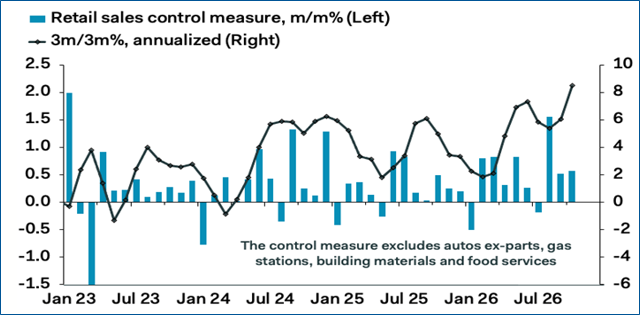
Despite heightened financial market volatility, consumers continue to spend. October retail sales exceeded expectations, with control group sales—a measure that feeds into the calculation of GDP—rising 0.6%, twice the consensus forecast of 0.3%. Sales for the previous two months were also revised higher. Over the latest three-month period, control group sales increased at an annualized rate of 8.5%, up from 6.1% in September. A relatively stable labor market and the positive wealth effect associated with higher stock prices have helped sustain consumer spending.
This Week
The economic calendar is relatively light during the holiday-shortened week. However, investors will continue to monitor developments surrounding AI investment, monetary policy expectations, and the recent signs of stress in credit markets. Lighter holiday trading volumes could also amplify market moves.
Chart of the Week
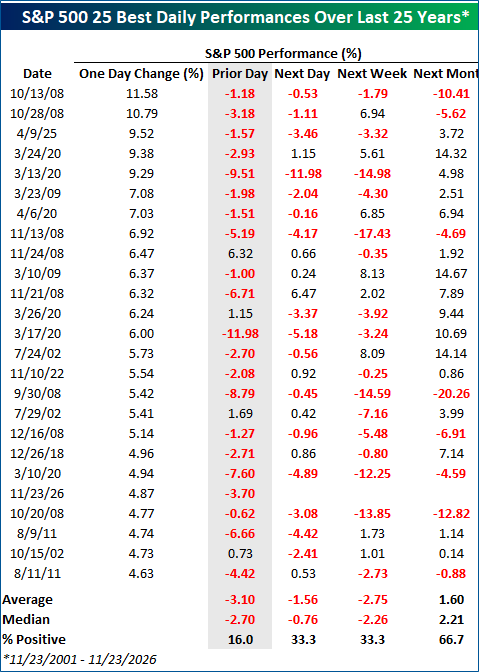
Monday's sharp rally in the S&P 500 serves as another reminder that the market's best and worst days often occur in close proximity to one another. In fact, of the 25 best days listed in the table below, several came the day after one of the worst trading days over the last 25 years. The data also suggest that sharp rallies do not necessarily mark the end of a period of market turbulence.
Written By Brian Presti
--
Brian Presti, CFA®, Chartered SRI Counselor℠, is Chief Investment Officer and a shareholder at TFC Financial Management. He oversees the firm’s investment strategy, asset allocation, sustainable responsible investing, and portfolio management processes and leads the firm’s Investment Committee. Prior to joining TFC in 2023, Brian was Director of Portfolio Strategy at The Colony Group, Chief Investment Officer of Harvest Capital Management and an equity analyst and portfolio manager with DL Carlson Investment Group. He began his career in 1997. As CIO, he is responsible for evaluating investment managers and implementing portfolio strategies designed to support long-term client objectives.
--
Disclosures:
- Registration with the SEC should not be construed as an endorsement or an indicator of investment skill or acumen.
- Past performance is not indicative of any specific investment or future results. Views regarding the economy, securities markets or other specialized areas, like all predictors of future events, cannot be guaranteed to be accurate and may result in economic loss to the investor.
- Investment strategies, philosophies and allocation are subject to change without prior notice.
- The securities identified and described do not represent all of the securities purchased, sold, or recommended for client accounts. The reader should not assume that an investment in the securities identified was or will be profitable.
- Any references to outside content are listed for informational purposes only and have not been verified for accuracy by the Advisor.
- This communication may include opinions and forward-looking statements. All statements other than statements of historical fact are opinions and/or forward-looking statements (including words such as “believe,” “estimate,” “anticipate,” “may,” “will,” “should,” and “expect”). Although we believe that the beliefs and expectations reflected in such forward-looking statements are reasonable, we can give no assurance that such beliefs and expectations will prove to be correct.