

Mon, August 3, 2026
Global equities advanced during an eventful week. Long-term U.S. Treasury yields rose. The week capped off a volatile month in which the S&P 500 finished close to where it started while breadth expanded.
Federal Open Market Committee (FOMC) Meeting and Press Conference
The FOMC left rates unchanged. However, there were three dissents (out of 12 voting members) in favor of a rate hike. Fed Chair Kevin Warsh received a fair amount of criticism after his press conference. We’ll reserve any judgement. This was Warsh’s second FOMC meeting and press conference, and we understand that he is taking a much different approach than his predecessors. Still, there were several comments and takeaways that appeared to confuse investors. Examples include a stated intolerance for above-target inflation without any policy action (or insights into what may spur action), comments that the recent rise in yields was doing some of the Fed’s work for them, and a potential shift from the emphasis on core PCE to yet to be named alternative measures.
Regardless of our or anyone else’s view, the most important opinion is ultimately the bond market’s. The yield curve steepened dramatically during and after the press conference. While it’s still early, the bond market may not be questioning if Warsh is committed to bringing down inflation but rather how the Fed intends to realize that objective.
Economic Data
Q2 GDP rose at an annualized 1.5% rate, below the expectation for 2% growth. However, drags from net trade and inventories masked solid underlying growth. Real consumption rose 3.2%, well ahead of the 2.3% estimate. Fixed investment continued to grow at a robust pace, supported once again by AI-related equipment investment and software and IP; both segments experienced double-digit growth.
Final sales to private domestic purchasers, a good barometer of underlying growth, grew at the fastest pace since Q1 2023.
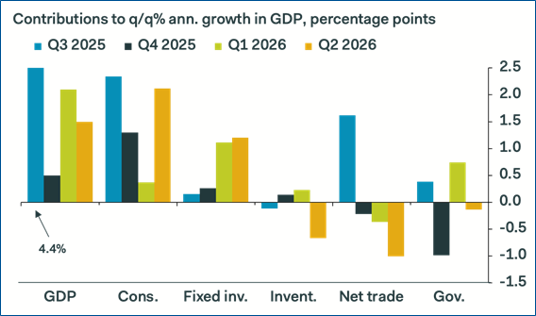
The June core PCE deflator rose just 0.13%, the smallest monthly increase since March. However, the deflator still grew at a 3.3% annualized rate in Q2. It remains to be seen if the deflator will continue to be the Fed’s preferred indicator going forward.
Markets
U.S. Equities
Earnings season is in full swing. Highlights last week included reports from several megacap technology companies, including three of the four hyperscalers (Alphabet reported last week). The mixed reactions reflected investors’ continued assessment of AI capital expenditures relative to the revenue and earnings these investments may generate. Microsoft and Amazon surged after their reports as investors cheered incremental progress on AI monetization. The former registered its largest single-day move since 2008. Conversely, Meta’s post-earnings reaction resembled Alphabet’s. Apple had one of its largest post-earnings declines after guiding sales lower due to supply chain constraints and input cost pressures.
Additionally, a highly levered hedge fund was forced to unwind all its public stock positions after its AI-related investment bets soured. The forced liquidation likely contributed to the recent carnage in many AI-related and momentum stocks and may have cleared out a source of the recent selling pressure.
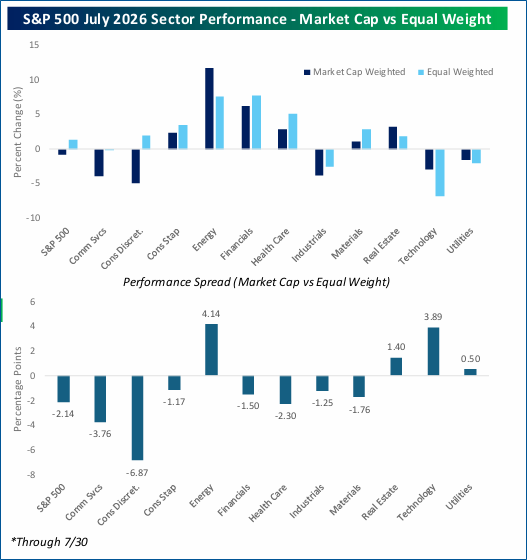
The S&P 500 advanced just over 1% for the week while the Russell 2000 index of small companies was flat. The week closed out a volatile month in which the S&P 500 essentially finished the month where it started but experienced considerable churn underneath the surface of the headline return.
International Equities
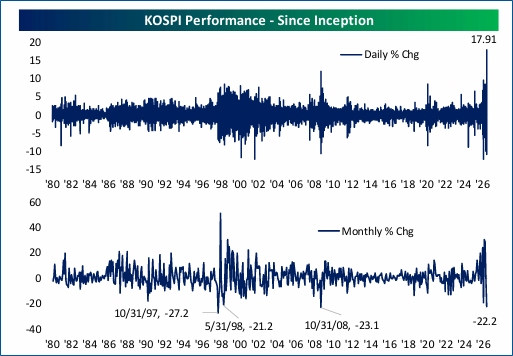
What a week for emerging markets, especially South Korea's KOSPI. The semiconductor-heavy index endured a three-day rout before surging nearly 18% on Friday, its best day ever. The recent volatility in the South Korean market has been historic.
At one point during the week, the broad MSCI Emerging Markets Index had halved its first half rally during July. However, the index jumped over 6% on Friday to close out the month on a strong note. Both European and Japanese equities rose for the week.
Eurozone inflation rose slightly more than expected in July, while Q2 GDP grew twice as fast as forecast (0.4% vs. 0.2%). The Bank of Japan kept rates unchanged. Over the weekend, the U.S. and Japan confirmed a joint intervention to stabilize the weak yen. China’s manufacturing PMI fell into contraction for the first time in five months in July.
Fixed Income
Two-year Treasury yields were essentially unchanged for the week, while 10-year and 30- year Treasury yields rose 0.10% and 0.15%, respectively. Despite higher rates, uncertainty over monetary policy, and escalation in the Middle East, both investment grade and high yield spreads have remained contained.
However, a notable development over the last several weeks has been a persistent (albeit gradual) widening in the lowest-rated high yield bonds. CCC-rated bond spreads have approached Liberation Day levels, suggesting growing stress among more highly levered companies.
This Week
Plenty of earnings and a fair amount of important economic data, including July PMIs and the July employment report.
Chart of the Week: Index Concentration
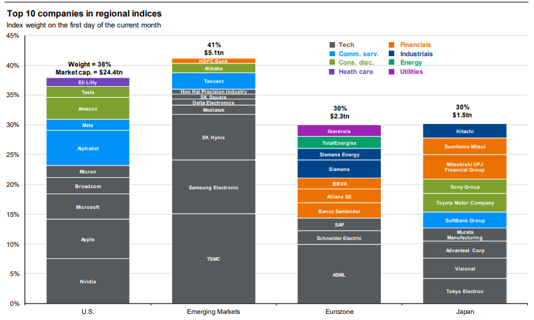
We have often discussed the top-heaviness of the S&P 500 and more recently the MSCI Emerging Markets Index. However, the primary developed market indices are less concentrated both in terms of individual stocks and sectors.
Written By Brian Presti
--
Brian Presti, CFA®, Chartered SRI Counselor℠, is Chief Investment Officer and a shareholder at TFC Financial Management. He oversees the firm’s investment strategy, asset allocation, sustainable responsible investing, and portfolio management processes and leads the firm’s Investment Committee. Prior to joining TFC in 2023, Brian was Director of Portfolio Strategy at The Colony Group, Chief Investment Officer of Harvest Capital Management and an equity analyst and portfolio manager with DL Carlson Investment Group. He began his career in 1997. As CIO, he is responsible for evaluating investment managers and implementing portfolio strategies designed to support long-term client objectives.