

Mon, August 10, 2026
Global equities rallied on the back of strong earnings, lower oil prices, and reduced odds of a Federal Reserve interest rate hike in September.
Economic Data
The highlight was the July U.S. employment report. Job growth was well below expectations. Payrolls fell by 23,000 jobs in July (consensus was +80K). The previous two months were revised down by a total of 103,000 jobs. Some of the weakness may reflect the reversal of temporary employment boosts earlier in the year. Additionally, government jobs fell 53K, mostly due to a one-time decline in education jobs at the end of the school year. Still, this was a soft report.
The 0.1% rise in average hourly earnings was below expectations for 0.3% growth. In a separate report issued last week, Q2 unit labor costs rose 1.3%, well below expectations for 2.1% growth. As it stands now, wage growth shouldn’t be a concern for the Fed.
The unemployment rate fell from 4.2% to 4.1%, likely due to a decline in the labor participation rate. The labor force participation rate represents the number of people working or actively seeking to work as a percentage of the working-age population. The labor force participation rate has been falling due to longer-term demographic trends, while recent declines may also reflect changes in labor-force composition and discouraged workers leaving the workforce.
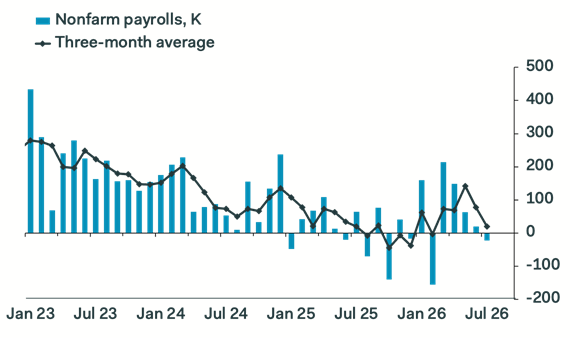
The report reduced the odds of a September rate hike, subject to incoming inflation data over the next several weeks. The case for holding rates steady was also bolstered by Q2 productivity growth, which rose at a 1.4% annualized rate, well ahead of expectations for 0.6% growth.
Markets
U.S. Equities
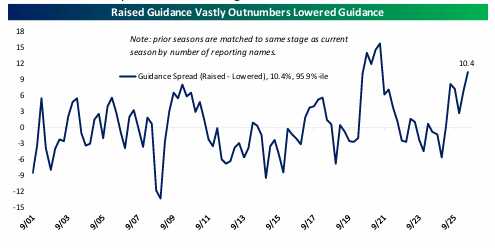
Q2 earnings season has been exceptionally strong thus far. Every sector in the S&P 500 except utilities has exceeded its initial earnings expectations, confirming the trend of broadening profit growth. According to FactSet, S&P 500 year-over-year revenue growth is tracking at 15% versus the 6/30 estimate for 12.2% growth. Moreover, the gap between the percentage of companies raising guidance and those lowering guidance has widened to its highest level in several quarters.
For the week, both the S&P 500 and the Russell 2000 Index of small companies rose just over 3.5%. The S&P 500 broke out of a tight trading range it had been in since May. The technology sector (+7.2%) was the clear winner for the week. Technology and materials were the lone sectors to outpace the broader S&P 500.
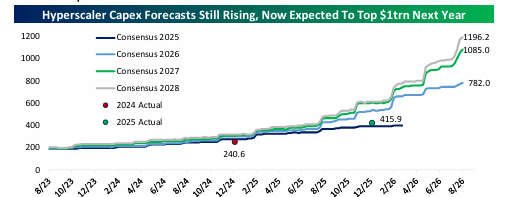
One key takeaway from earnings season is that hyperscaler capex continues unabated. While specific company reactions to earnings were mixed, the updated capex projections from the hyperscalers have provided renewed support for the broader AI ecosystem.
International Equities
The EAFE advanced over 2% while the MSCI Emerging Markets Index fell slightly. As we mentioned last week, the U.S. and Japan engaged in a coordinated intervention to stabilize the weak yen. This was the first joint yen-buying operation from Japan and the U.S. since 1998. The yen initially rallied but gave up some of its gain throughout the week. Time will tell if this was a one-and-done event.
Fixed Income
Bonds rallied after the release of the employment report. However, we’d note the rally was more tepid than we would have expected given the July data, the negative revisions, and the softer wage growth numbers.
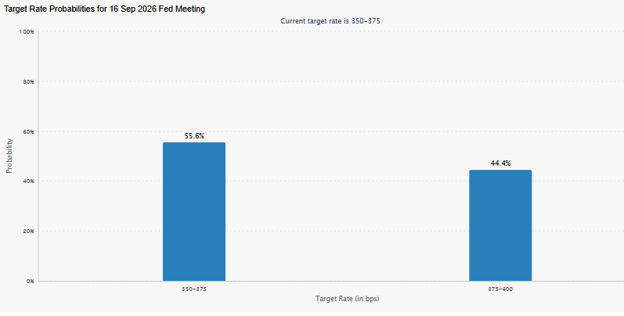
For the week, yields generally declined by around 5 basis points across the curve. Odds for a September hike fell to just under 50% from 67% a week earlier.
This Week
We’ll get important economic data including July CPI, PPI, and retail sales.
Chart of the Week
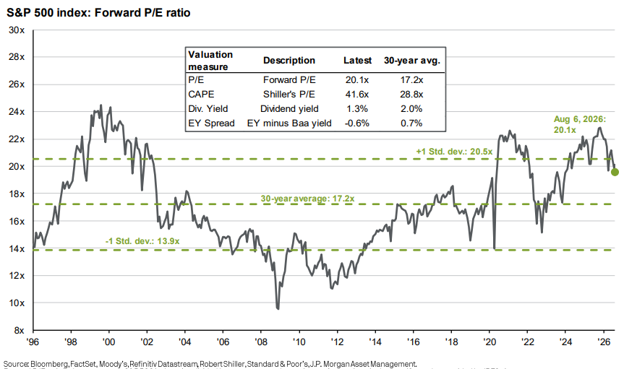
Most valuation metrics for the S&P 500 are well above their historical averages. However, the forward P/E ratio has actually compressed this year. Earnings growth has outpaced the rise in stock prices.
Written By Brian Presti
--
Brian Presti, CFA®, Chartered SRI Counselor℠, is Chief Investment Officer and a shareholder at TFC Financial Management. He oversees the firm’s investment strategy, asset allocation, sustainable responsible investing, and portfolio management processes and leads the firm’s Investment Committee. Prior to joining TFC in 2023, Brian was Director of Portfolio Strategy at The Colony Group, Chief Investment Officer of Harvest Capital Management and an equity analyst and portfolio manager with DL Carlson Investment Group. He began his career in 1997. As CIO, he is responsible for evaluating investment managers and implementing portfolio strategies designed to support long-term client objectives.