

Thu, September 3, 2026
Stocks traded in a tight range ahead of Fed Chair Kevin Warsh’s Jackson Hole speech on Friday and finished the week mixed.
Kevin Warsh's Jackson Hole Speech
Fed Chair Kevin Warsh delivered his first keynote address at the Kansas City Fed’s Jackson Hole Economic Symposium. The speech was widely anticipated given some of the uncertainty surrounding the July FOMC press conference.
Generally, Warsh reiterated his core principles of providing little forward guidance, not offering an explicit reaction function, and letting the markets form their own views based on their assessments of data. He did provide some incremental clarity, reaffirming the PCE price index as the Fed’s preferred measure of its 2% inflation objective. Warsh was positive on the economic outlook. He cited strong output, stable employment, robust corporate earnings, and easy financial conditions. However, he was less sanguine when it came to inflation. He referenced the more encouraging data recently but stated the data “do not tell me that underlying trends have meaningfully improved.” He also emphasized “we must be confident that underlying inflation is moving to our objective, clearly and at sufficient speed. Otherwise, we have work to do.”
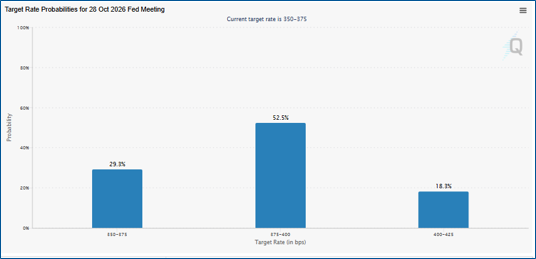
Market-implied odds of a September rate hike rose to just under 60% on Friday afternoon, up from 35% before the speech.
Economic Data
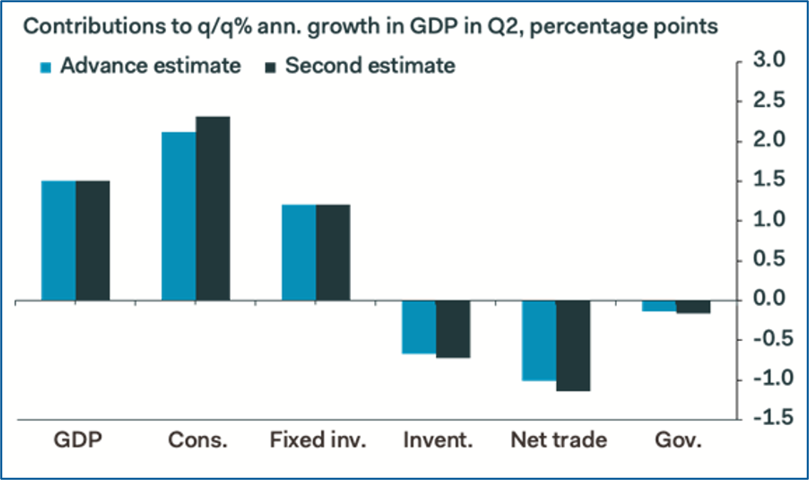
Second-quarter real GDP growth was unrevised at a 1.5% annualized rate. The upward revision to consumption was offset by a higher drag from trade. Real final sales to private domestic purchasers (a good barometer for broad economic growth) were revised up to 4.2% from 3.9%.
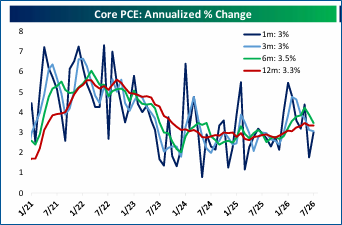
The core PCE deflator remained unchanged at 3.3%. While core PCE is not accelerating sharply, it has yet to show meaningful progress towards the Fed’s 2% target.
Markets
U.S. Equities
Stocks were mixed as the S&P 500 rose 0.50% while the more interest-rate sensitive Russell 2000 index of small companies fell 1.49%. For the week, the technology, communication services, and financials sectors were positive while all other sectors declined.
The highlight of the week was Nvidia’s earnings report. After initially declining after earnings were released, the stock surged after CEO Jensen Huang surprised investors by issuing fiscal 2028 guidance-which projected 70% revenue growth. Analyst estimates had projected around 50% growth. Nvidia’s earnings and guidance suggested that AI demand and spending remain robust with few signs of a slowdown in the broader AI investment cycle. However, the debate surrounding monetization will likely persist, especially in light of higher costs (e.g. memory prices and the cost of capital). Nvidia announced a 15% increase in chip prices. We expect continued leadership rotations between the hyperscalers, semiconductors, and software companies within the technology sector.
International Equities
Both developed and emerging markets’ benchmarks were essentially flat for the week. Global economic data released during the week (e.g. German business activity surveys, Japan machine tool orders, South Korean business sentiment indices) point to continued improvement in capital spending and manufacturing activity outside the U.S.
Fixed Income
The treasury yield curve flattened significantly after Warsh’s speech. The 2-year treasury yield jumped nearly 12 basis points, the largest single-day yield gain following a Jackson Hole Fed Chair speech. Longer-term yields rose only slightly. The modest rise in longer-term yields may reflect confidence that a more restrictive Fed would help contain inflaton and, in turn, limit upward pressure on longer-term rates. However, it may also reflect the potential for more Treasury intervention in the bond market in addition to the recently announced doubling of long-term bond purchases. Still, a continued drift higher in yields would likely pose a near-term challenge for equities.
Currently, there is a 57% chance of a rate hike at the September meeting and a 70% probability of one or more hikes by the end of the October meeting. Note that August employment and inflation data will be released before the September FOMC meeting.
This Week
This week’s key economic releases include the August employment report and the manufacturing and services PMIs.
Chart of the Week
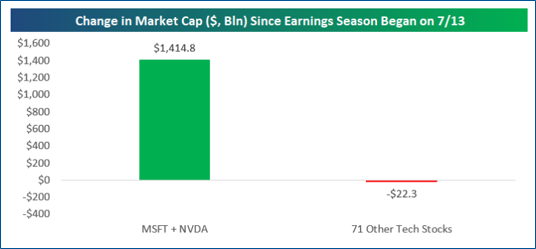
As of Friday’s close, the S&P 500 has added $1.75 trillion in market capitalization since earnings season began on 7/13. The technology sector accounted for approximately 80% of the increase. Within the technology sector, two stocks, Microsoft and Nvidia, have accounted for that entire gain.
Written By Brian Presti
--
Brian Presti, CFA®, Chartered SRI Counselor℠, is Chief Investment Officer and a shareholder at TFC Financial Management. He oversees the firm’s investment strategy, asset allocation, sustainable responsible investing, and portfolio management processes and leads the firm’s Investment Committee. Prior to joining TFC in 2023, Brian was Director of Portfolio Strategy at The Colony Group, Chief Investment Officer of Harvest Capital Management and an equity analyst and portfolio manager with DL Carlson Investment Group. He began his career in 1997. As CIO, he is responsible for evaluating investment managers and implementing portfolio strategies designed to support long-term client objectives.