
Wed, July 15, 2026
Second Quarter 2026 Review: Strong quarter but time to curb our enthusiasm
Executive Summary
Despite geopolitical tensions, a commodity supply shock, changing Federal Reserve leadership, and a growing debate surrounding artificial intelligence spending, the global economy and financial markets remained resilient during the second quarter.
The most encouraging development in the U.S. market was beneath the headline returns. Market gains have been driven by a wider variety of sectors and company sizes. Broader participation generally reflects healthier market conditions than rallies driven by only a handful of companies A key theme in our 2026 outlook was the likelihood of a more durable market rotation given strong policy underpinnings, broadening earnings growth, and greater investor scrutiny around AI spending from mega-cap technology companies. Thus, when technology stocks experienced periods of profit-taking, participation expanded across financials, healthcare, industrials, and small to mid-sized companies.
Our base case scenario remains one of continued economic expansion, positive earnings growth, and expanding market breadth. However, after a strong first half, we believe investors should expect a more uneven path forward. Market rotations are ultimately healthy but can be bumpy. We’ll highlight three risks that may cause periodic turbulence in the months ahead.
Global Economic Review
Key Developments
U.S. growth supported by consumption and fixed investment
European and Japanese central banks hiked rates
Emerging markets: AI-levered economies booming; China sluggish
Like Q1, Q2 U.S. economic growth was supported by consumer spending and business fixed investment. Despite sharply higher gasoline prices during the quarter, consumer spending exceeded expectations. The annualized rate of growth in the control measure of retail sales for the three months ending in May (compared to the previous three months) accelerated at the fastest rate since June of 2022. June retail sales moderated but were still healthy.
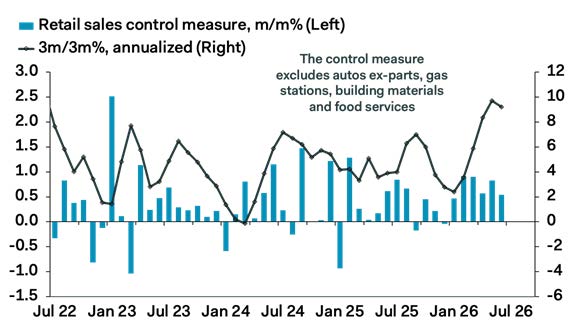
Higher tax refunds compared to last year helped mitigate the effect of higher prices at the pump, although that tailwind will recede over the coming months. Spending remains bifurcated with upper-income cohorts supported by higher asset prices and stronger wage growth while lower to middle-income consumers continue to feel the pinch of sticky inflation and declining real incomes.
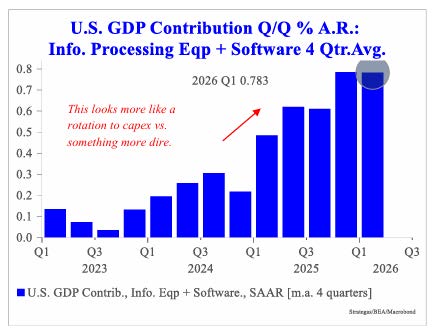
Fixed investment grew at a robust pace and was supercharged by accelerating AI infrastructure spending. While residential fixed investment declined 6.2% on a quarter-over-quarter annualized basis in Q1, investment in equipment and IP and software grew 17.2% and 11.6% respectively. According to the Federal Reserve Bank of St. Louis, non-residential fixed investment contributed approximately 1.4% of the 2.1% annualized real GDP growth in the first quarter.
Based on preliminary data, AI-related investment contributed meaningfully to growth in Q2 as well, highlighting the growing importance and potential concentration risk of AI investment to economic growth.
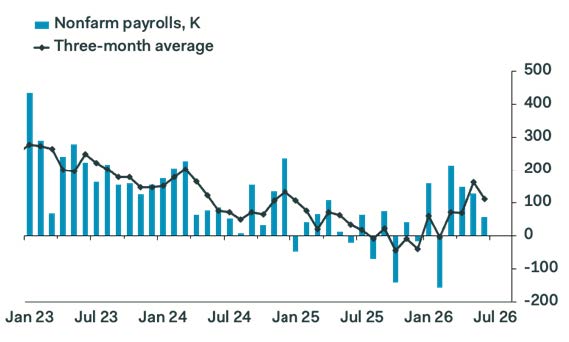
The labor market improved in the second quarter, although we believe it’s too early to call an end to the “little hiring, little firing” trend of the last several months. The pace of monthly job growth picked up in April and May before stepping back in June. While the three-month average increase of 111k is better than any similar period in 2025, forward-looking indicators are mixed. Hiring intentions surveys from the NFIB, regional Federal Reserves, and Census Bureau suggest subdued growth in the next few months.
Economic growth in international economies was mixed. In the Eurozone, economists have lowered their growth expectations. European economies have a higher sensitivity to energy prices since they are significantly more dependent on imported energy than the U.S. Additionally, energy accounts for a larger share of consumers’ disposable income. While the inflation shock caused by disruptions to Middle East energy flows may have peaked, it could usher in a more prolonged period of above-target inflation and slower growth than in the pre-war outlook. The European Central Bank raised its policy rate by 0.25% in June to counter the effects of higher energy and commodity prices.
The Bank of Japan (BOJ) also raised its policy rate by 0.25% to 1.0%, the highest level since 1995. The BOJ has signaled a willingness to speed up the pace of monetary policy normalization against a backdrop of firming consumption and rising wages.
Select emerging markets have been disproportionate beneficiaries of the AI infrastructure buildout due to their reliance on semiconductor exports. For example, in South Korea the global semiconductor boom led to year-over-year export growth of 59.5% in June. The country’s finance ministry recently raised its 2026 GDP forecast to 3.0%, up from the previous forecast of 2.0% and last year’s 1.1% pace.
Conversely, growth in China slowed to 4.3% in Q2, below the official 4.5% to 5.0% target for the year. China withstood the global energy supply shock reasonably well but has been weighed down by weak consumption and fixed investment.
Asset Class Performance Review
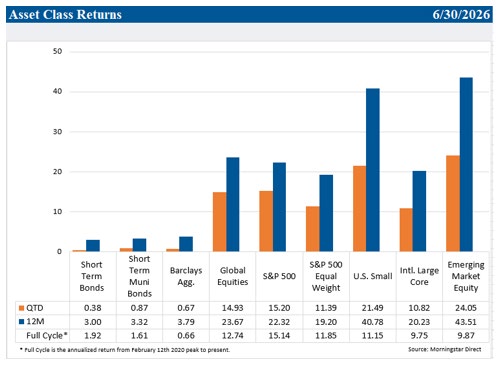
U.S. Equities
Key Developments
Another quarter of strong earnings growth
Market rotations continue
Historic quarter for semiconductor stocks
Small caps shine
U.S. stocks were buoyed by another quarter of exceptional earnings growth. S&P 500 earnings grew 29% year-over-year, far outpacing the 15% growth rate expected at the beginning of the reporting season. 85% of S&P 500 companies exceeded earnings estimates. The technology sector accounted for the largest share of earnings growth, but other sectors such as financials, materials, and consumer discretionary also posted impressive growth rates.
Rotation has been the defining theme during the quarter and throughout this year. The market has experienced both style and market cap rotations. In the second quarter the Russell 2000 index of small companies rose over 21%, capping its best first-half performance since 1991. Through June 30 the Russell 3000 Value Index outperformed the Russell 3000 Growth Index by nearly 11%. There are several reasons behind this improvement in market participation. In our opinion, the key has been the shift in relative earnings growth expectations between mega-cap technology stocks and “the rest of the market.”
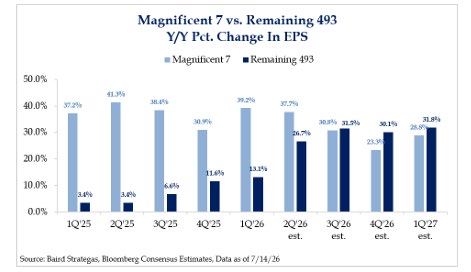
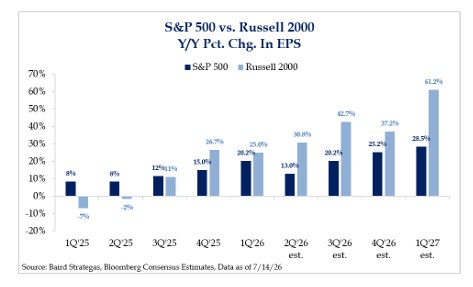
This does not mean investors abandoned technology stocks. Rather, leadership broadened while technology continued to generate strong returns. The technology sector was still one of the top performing sectors in the first half of the year. Semiconductor memory stocks surged during the quarter, especially after the hyperscalers (Alphabet, Amazon, Meta, and Microsoft) substantially raised their 2026 spending forecasts. The massive need for computing power has led to a shortage of high-bandwidth memory that may last beyond 2026. The Philadelphia Semiconductor Index rose nearly 90%, which surpassed any quarterly gain from the late 1990s.
International Equities
Key Developments
Emerging Markets=All about semiconductor stocks
Developed markets resilient despite war and a stronger dollar
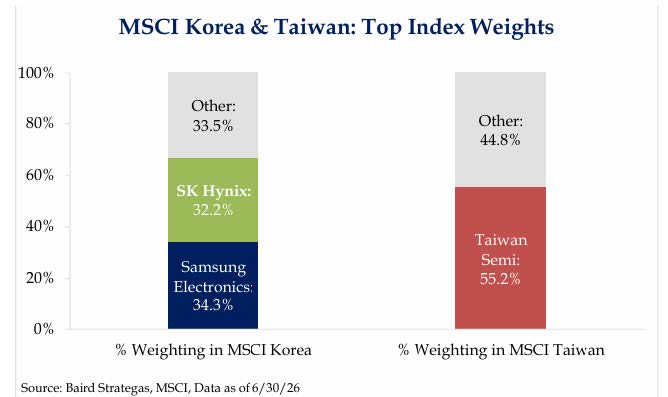
The MSCI Emerging Markets Index rose over 24% during the quarter. This gain is definitely a case where the headline index return doesn’t tell the full story. The rally was disproportionately influenced by a small group of semiconductor stocks which comprise a large weighting in the index.
For example, two stocks make up around 50% of the entire South Korean Kospi while South Korea and Taiwan now account for nearly 50% of the entire emerging markets index. And we thought the U.S. market was concentrated!
The dollar rose against most developed market currencies. Japan was the top performing market as it benefitted from global demand for semiconductor and AI-related exports. Despite lowered growth expectations and higher rates, Europe performed well due to strong performance from financial and industrial stocks.
Fixed Income
Key Takeaways
A new regime
Interest rate hikes back on the table
Yields drifting higher
Bond investors navigated a shift in Federal Reserve leadership and monetary policy during the quarter. Kevin Warsh debuted as Fed Chair. There were two main takeaways from the Federal Open Market Committee’s (FOMC) June meeting and Federal Reserve Chair Kevin Warsh’s first press conference. First, the Fed now has a hiking bias. Nine of the eighteen meeting participants project one or more 0.25% rate increases this year. Eight expect the policy rate to remain unchanged, while one participant projected a cut. The Fed also raised its estimate of 2026 core inflation from 2.7% to 3.3%. Additionally, the sentence “The Committee will deliver price stability” was emphasized by Warsh repeatedly during the press conference.
Second, the FOMC did not include any forward guidance in its rate policy statement. In fact, the statement was the shortest since 2007. This shouldn’t have been surprising given Warsh’s past criticism of forward guidance, a view he reiterated during his recent nomination process. We can expect less forecasting or projections from the Fed going forward. Warsh has also established five task forces, each dedicated to evaluating potential changes in how the Fed communicates and conducts policy.
Three Risks We Are Monitoring
Shifts in AI Capex
While broadening earnings growth and increased market breadth are encouraging, the AI infrastructure buildout remains a key driver of U.S. equity performance and economic growth. The hyperscalers are expected to spend hundreds of billions of dollars this year on AI investment. Earlier we mentioned semiconductor companies as key beneficiaries of this spending, but the positive effects span to networking equipment manufacturers, data center operators, utlities, basic resource companies and even “old economy” companies involved in power and energy infrastructure.
Investors are increasingly questioning the capacity of the hyperscalers to generate attractive long-term returns on these extraordinary infrastructure investments. More recently, the use of equity and debt markets to finance this capex has compounded these concerns. Furthermore, input costs are increasing. Capital intensity has surged while free cash flow has deteriorated.
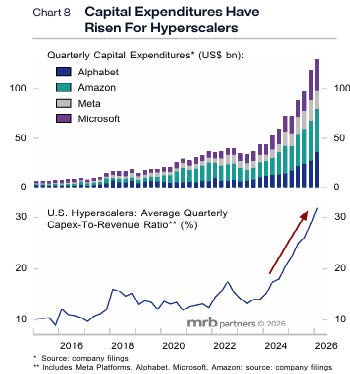
The hyperscalers may continue to invest aggressively in the near term, but ultimately if the pace of AI monetization does not pick up, they could delay or reduce their AI expenditures. Furthermore, voter unrest toward data centers is gaining steam. Several states have passed restrictions on data center construction or eliminated subsidies and tax incentives. New York recently placed a one-year moratorium on data center projects.
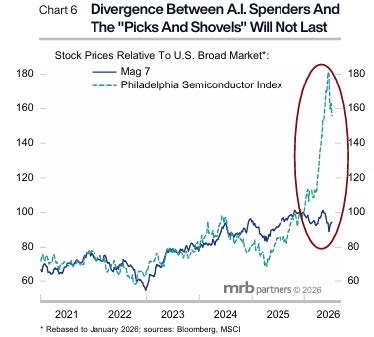
Thus far, investors have been rotating within the AI ecosystem as the overall technology sector has advanced. In July semiconductor stocks have sold off after their performance gap relative to the Mag 7 reached extreme levels.
The growing risk is that the concerns outlined above (not to mention increasing competition from China) cause a broader exodus out of technology. Hyperscalers and semiconductor stocks together comprise roughly 35% of the S&P 500.
We’ll be closely monitoring any updates on capex projections and monetization timelines during the upcoming earnings reporting season.
War with Iran
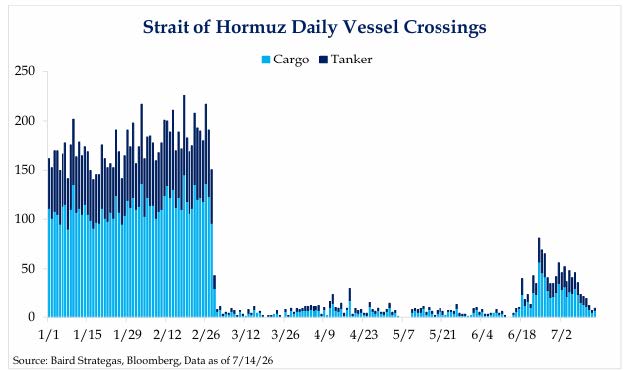
After several weeks of relative calm, the conflict in the Middle East has perhaps entered its most unpredictable phase. Iran has formally suspended the Memorandum of Understanding with the U.S. Reciprocal escalation is now hitting key infrastructure in several Gulf countries. Traffic through the Strait of Hormuz has slowed to a crawl. A growing risk is that Iran directs the Houthis to close Bab el-Mandeb, another vital strait.
The ultimate outcome is impossible to predict. We have witnessed how escalation can quickly lead to de-escalation. The strong underpinnings of the global economy enabled markets to withstand the initial phases of the war. However, the longer hostilities persist, and the greater the damage to energy infrastructure and supply chains, the more likely commodity prices remain elevated, potentially affecting growth, consumption, and monetary policy.
Inflation and Interest Rates
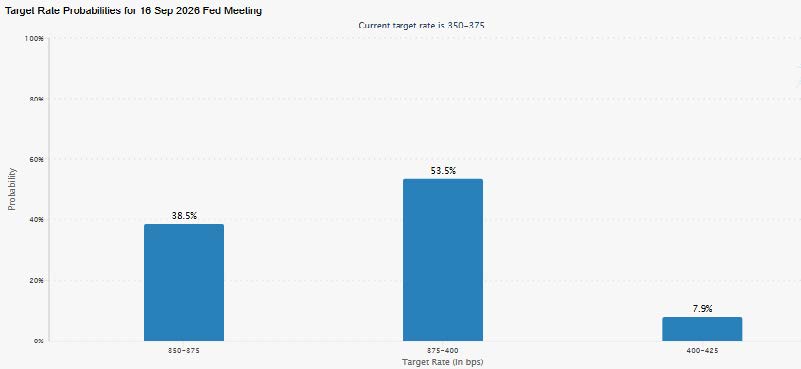
Another risk is that inflation proves more persistent than expected, leading the Fed to begin hiking interest rates later this year. Warsh has been vocal about the need to bring down inflation, stating the Fed has “no tolerance” for persistently elevated prices. Despite encouraging CPI and PPI data last week, commentary from Fed officials continues to lean hawkish. Renewed hostilities in the Middle East are a complicating factor. The effects of higher oil prices likely peaked in May. However, after recently declining to pre-war levels, oil prices are again moving higher. Ultimately, we believe wage growth will be the key metric to monitor.
As it stands now, the probability of one or more hikes by the September FOMC meeting is just over 60%.
Portfolio Strategy: What does this all mean for investors?
We believe the risks outlined above are not trivial and may lead to a more challenging second half of the year for investors. Moreover, these risks are accompanied by the high bar of elevated earnings expectations, especially for technology stocks. However, we do not expect a recession or bear market. Broadening earnings growth, improving market participation, and resilient economic fundamentals should continue to provide underlying support for markets.
Regarding portfolio strategy, our diversified U.S. equity portfolios are well-positioned for a more durable market rotation. Additionally, our tilt toward quality companies should provide resilience. Investors have historically favored companies with high returns on equity, stable earnings growth and low levels of debt during periods of higher volatility.
Developed International stocks are certainly not immune to the risks of higher inflation and a prolonged war with Iran. However, they offer attractive valuations and are less sensitive to shifts in AI capex or the broader AI narrative.
We continue to emphasize high quality in our fixed income portfolios. Bonds should continue to provide reliable, predictable, and healthy levels of monthly income. Lastly, diversifying assets should continue to provide valuable portfolio benefits and may act as a port in the storm during periods of elevated bond and equity market volatility.
As always, we remain vigilant that portfolios are aligned with their long-term asset allocation targets and continue to rebalance where appropriate. We are also mindful of providing sufficient liquidity for upcoming cash needs.
Please contact your TFC Advisor or us directly if you have any questions or would like to discuss your portfolio further. Thank you.
Sincerely,
--
Brian Presti, CFA®, Chartered SRI Counselor℠, is Chief Investment Officer and a shareholder at TFC Financial Management. He oversees the firm’s investment strategy, asset allocation, sustainable responsible investing, and portfolio management processes and leads the firm’s Investment Committee. Prior to joining TFC in 2023, Brian was Director of Portfolio Strategy at The Colony Group, Chief Investment Officer of Harvest Capital Management and an equity analyst and portfolio manager with DL Carlson Investment Group. He began his career in 1997. As CIO, he is responsible for evaluating investment managers and implementing portfolio strategies designed to support long-term client objectives.
Renée Kwok, CFP®, is President and CEO of TFC Financial Management, a fee-only registered investment advisor providing comprehensive financial planning and wealth management services. She has over three decades of experience advising individuals and families on investment strategy, retirement planning, tax planning, and multi-generational wealth management. Renée joined TFC Financial in 1991 and leads the firm’s financial planning and investment advisory services while serving on the firm’s Investment Committee. Prior to TFC, she worked as a security analyst at Putnam Investments and as an investment analyst at Asian Oceanic Limited, a Hong Kong merchant bank.